Showing posts with label small business. Show all posts

Friday, June 24, 2011

Tax Worries for Small Business Owners

Tax Worries for Small Business Owners
New figures indicate small business owners are anxious about tax time.

A massive 91 per cent of new small business owners have very little understanding of their annual tax obligations, while 84 per cent are unsure of the things they can claim as a business expense. This was revealed by the American Express Tax Time Survey.

According to Jason Fryer, head of small business services at American Express, understanding GST and the consequences of making a mistake cause a lot of worry amongst small business owners.

“Setting up your own business can be like jumping into the unknown. Our Tax Time Survey shows that completing the business tax return for the first time is often fraught with anxiety,” he said.

“The research shows that almost all new business owners wonder at some stage if they have complied with the latest tax legislation and whether they will fall foul of the tax office if they make a mistake,” Fryer added.

From the more than 500 Australian businesses that were surveyed by Galaxy Research, it was found out that 74 per cent of operators find it a burden to complete their business activity statements. The results further revealed that aside from cash flow management, tax related issues are also considered stressful for many business owners.

Taxation expert and author Adrian Raftery says, “The American Express research reveals considerable uncertainty among small business owners about tax reporting and what they can and can’t claim, which contributes to negative feelings about completing tax returns.”

“In fact, the two most common questions I am asked by small business owners at tax time are, ‘what is the likelihood of my business being audited?’ and ‘who are the ATO targeting this year?’ – demonstrating the level of concern among business owners,” he added.

American Express suggested to help relieve taxation stress of business owners that they should keep receipts and use one business card in order to keep personal and office spending organized.

Source: The Shout »

Thursday, June 23, 2011

Cash Flow Problems of Small Businesses in Australia

Research has shown that the biggest challenge of small businesses today is cash flow. Delinquent accounts increased by 20 per cent in the March quarter with payments over 90 days late.

This problem has been caused by customers delaying payments. The situation is compounded as the government incentives of 2009-2010 have already ended before the economy has reached the level required by small businesses to survive. To add to the problem, the natural disasters in Queensland and Victoria had adverse effects on small businesses in parts of Australia.

On a national perspective, the difficulty of small businesses is not reflected as it is heavily influenced by the mining industry’s momentum.

Here are possible solutions for small business owners.

Mark O’Donoghue, Finlease Finance Broker, said that it would help to talk to a specialist business broker. The advice of a specialist is free and offers practical solutions.

“One readymade solution is debtor finance. This is a facility that can fund your receivables which you may not otherwise be able to recoup from your customers for weeks or months. In other words, the finance pays your bills so that you can meet your ongoing commitments to keep running your business efficiently. You’ll receive up to 80 percent of your invoice, eliminate the immediate hassle of collecting payments and will be able to fund current operations without incurring further debt,” he added.

Another practical solution is to encourage customers to pay in advance and then give them discounts when they do so. And for those customers who are the worst payers offering them a big discount to pay promptly can help ease the situation.

Source: DynamicBusiness.com.au »

Sunday, June 12, 2011

COSBOA Warns Minimum Wage Increase Will Hurt Small Business

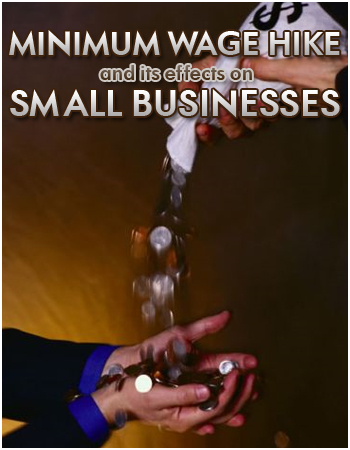
Minimum Wage Hike and its effect on Small Businesses
COSBOA, or the Council of Small Business of Australia, has given a warning that the upcoming minimum wage increase will definitely hurt small businesses.

Fair Work Australia has lifted the minimum wage from $569.90 to $589.30 per week last Friday (3rd June). The increase of $19.40 per week has come midway between the union’s call for a $28-rise per week and the business bodies’ call of a $10 increase. COSBOA is among the business bodies.

According to COSBOA executive director Peter Strong, the ruling is a pay decrease for small businesses even if employees are a getting a pay increase.

“People need more money and we understand that, but small businesses don't get a lot of money,” said Strong. “At the moment, small business is a lot of hard work. We're just here to make a living and it impacts on small business owners' family income,” he added.

COSBOA (Council of Small Business of Australia)
It was also said that the government cannot give any more money to small businesses. However, it can help them by giving them more tax breaks. The government can also help by removing red tape. GST and superannuation payments should also be looked at.

Around 1.4 million workers will be affected by the Fair Work ruling that will take effect on July. This ruling amounts to 3.4% rise above inflation.

After the Australian Chamber of Commerce and Industry (ACCI) initially lobbied for a $9.50 weekly increase, it said that the ruling is excessive.

The wage increase will add another $3 billion to the wages bill of small businesses of Australia, according to ACCI Chief Executive, Heather Ridout.

“While not wanting to overstate the risks, it has to be said that in the current circumstances faced by non-mining, trade-exposed sectors such as manufacturing and tourism, the decision is sure to further erode margins and will weigh against decisions over retentions and new hiring,” she added.

News Source: SmartCompany.com.au »

Wednesday, June 8, 2011

Super Coalition Plan Welcomed by Small Business

The Coalition’s plans for the tax office to process superannuation payments on behalf of small business have been welcome by the Council of Small Business Organizations of Australia (COSBOA). This proposal has been dubbed as the “first real removal of red tape for the sector in memory.”

The coalition proposes that small businesses will be allowed to transfer its total employee entitlements to the Australian Taxation office and the Taxation Office will distribute the payments to the relevant super funds.

According to COSBOA Executive Director, Peter Strong, this proposal will save time, effort and money for SME’s.

“It's so sensible; there are no losers. We've been pushing this for years,” says Strong.

Furthermore, Strong says that the government’s current superannuation clearing house is a “good thing”. However, it is not easy to engage and the businesses that are best suited to it are just too busy to try it.

The system, according to the government, is simple, free, and available to companies with less than 20 employees. There have already been 4,356 who have signed up with the clearing house as of June 3. Around 28,855 employees have been added to the system while 84,025 employee payments have been made.

“People would say that's not much, but it's my time,” says Strong.

“Super is one of the biggest problems when employing somebody: who are they a member of and becoming a kind of financial adviser by having a default fund in place,” Strong adds.

Small Business Minister, Nick Sherry, says that the Coalition would stop mindlessly opposing their tax cuts for two million small businesses if it truly cared for them.

“Today's announcement by Tony Abbott is just more empty and hollow words, which can't be believed,” said Sherry.

News Source: Smart Company »

Wednesday, June 1, 2011

Small Businesses Now More Willing To Borrow

Small Businesses are more eager to loan from banks
There is more willingness on the part of small businesses to borrow. This is due to increased competition amongst the banks. A significant boost to the big four’s loan books may not show for a few months yet.

Businesses of all sizes have shown their willingness to borrow over a 12-month horizon since November 2010. However, research firm, DBM consultants reported on Tuesday that expectations declined in April for all except for the smallest micro-sized enterprises.

These micro-sized enterprises represent 89 per cent of all Australian businesses of which 39 per cent of them do not have loans. Furthermore, they have annual leftovers of less than $1 million. Those with annual turnovers of around $200,000 are expecting to change their debt levels over the next 12 months.

Sentiment was assessed and found to be strongest amongst miners, insurers, and other financial services firms. The weakest, on the other hand, is among those in retail, agriculture, tourism and construction sectors.

DBM has been commissioned by the four banks to conduct surveys. Among the top concerns listed by all businesses are rising interest rates and business costs.

John Hinchy, DBM’s Chief Statistician, describes the mismatch between borrowing expectations and business sentiment for micro-sized businesses as a conundrum.

However, Colin Whitehead of Fat Prophet says this observation is probably because businesses want to borrow in order to plug their cash flow problems.

He also stated that the competition among lenders to win business loans is driving these small businesses to increase their borrowings. “The banks are competing more actively in that space, therefore they are likely to improve the terms,” said Whitehead.

The top end of town only represents 0.3 per cent of Australian businesses, but it covers about 40 per cent of all Australian borrowings. Meanwhile, small businesses only account for 15 per cent of all Australian borrowings.

Monday, May 30, 2011

Turn Your Business Into a Franchise

Turn your business into a franchise.
According to Wikipedia, a small business is a business that is privately owned and operated, with a small number of employees and relatively low volume of sales. Small businesses are normally privately owned corporations, partnerships, or sole proprietorship. However, any small business need not stop at this level. There could be a chance that this will work out for another person or group in the form of a franchised agreement.

Franchising, on the other hand, is practicing another company’s or firm’s business model based on terms and conditions or an agreement.

So here are 10 questions that must be asked to know if a business is good for franchising.

1. Is your business really successful-and different?

It has to be proven that your business has been successful throughout the years and has a good track record. It also has to be made sure that there are is solid evidence supporting this claim.

A business also has to be different and unique in order to catch a wide market base.

2. Could that success be replicated?

A franchisee should not need to acquire new specialized skills but rather be able to apply the systems and methods provided to reproduce the successful operation of the business.

3. Do you have a standout brand?

This is important because franchisees would want a company that already has an established name and a high-level recognition in the market.

4. Do you have detailed, tested business systems?

A franchisee would want to know if all the elements or components of the business are already in place. They should not want have to work things out for themselves.

5. Can your business continue to adapt, evolve, and grow?

Handling a business also means being able to constantly adapt to the changes and challenges around. Competition and new market conditions can destroy even successful companies if they do not adapt.

6. Have you got the necessary skills and attitudes?

Famous business franchises
Being in a business is a tough job to do. When you attempt to extend running your business to running a franchise groups additional skills have to be developed. For example communication skills will be required to train the franchisees.

7. Can you create a realistic market plan?

It is important for the business owner to hire professionals to help in the marketing plan. Since the company is looking for possible franchisees, it is important to be ready with the marketing plan that will help convince possible franchisees. This may include having to promote the franchise brand, help franchisees market their individual businesses and market the company’s franchise offer to possible franchisees.

8. As a franchiser, can you keep adding value to the businesses?

Being a franchiser does not mean staying confident, complacent and relaxed the whole time expecting the money to keep rolling in. Remember that competition always has changing trends and the franchiser has to develop and refine their business model to stay ahead.

9. Will you have adequate financial reserves?

Make sure the company has financial reserves in place to support franchisees in the initial stages.

10. Do you have access to specialist franchising expertise?

The franchiser has to make sure that the company has access to specialist franchising expertise. Franchising involves complex legalities which may be difficult to handle for the business owner themselves. Expert advice is the best option to yield the best results.

Franchising is not a simple thing. It involves larger management coverage and should therefore be well thought through before being undertaken.

Tuesday, May 24, 2011

New Small Business Tribunal Created To Resolve Disputes

In an effort to speed up resolutions to small business disputes and to minimize costs incurred by small businesses involved, a new national small business tribunal has been created by the Australian government.

Nick Sherry, Federal Minister for Small Business, was the one who proposed this tribunal option in an options paper that was released.

The following key ideas are contained in the paper:

1. A National Information and Referral Service - this includes a website and a telephone line that directs small businesses to other services in their area.

2. A National Dispute Resolution Service - will provide referrals and information and offer low-cost mediation.

3. A National Small Business Tribunal - will deal with small business disputes backed by Commonwealth legislation.

4. A Small Business Advocate - would independently represent the interests of small businesses to the Australian government.

According to Sherry, the small business tribunal will serve as a “one-stop shop” for disputes and will be backed up by commonwealth legislation.

It has been found out that one in five small businesses, or about 20 per cent of Australia’s 2 million small businesses, had been involved in a dispute with another small business in the past five years according to the survey conducted by the Department of Innovation, Industry, Science and Research (DIISR). Around 2/3 of these cases were payment-related while around 9 per cent were serious.

It was also further found out that many small businesses did not know where to go with the disputes. However, if they knew, they also hesitated due to financial concerns.

"My aim is to bring about a national business-to-business disputes resolution process that is accessible, prompt and as low cost as possible for small businesses," Sherry said.

He added that the aim of the tribunal is to keep disputes out of court especially those small business disputes that only require low-cost and speedy services.

News sources: Smart Company | Sydney Morning Herald | Herald Sun | Queensland Business Review

Monday, May 23, 2011

ACCI says Small Business Confidence Stays Weak

A business lobby group says that the confidence in small businesses has remained weak. This is primarily because of the high Australian dollar and the likelihood that interest rates will be raised.

The index for business conditions was 43.8 points in the March quarter which is only higher by 0.1 compared to the previous period. This was revealed in the small business survey by the Australian Chamber of Commerce and Industry or ACCI. Figures below 50 indicate a contraction in the economic conditions of small businesses.

They had expected a better performance of 49.3 index points.

"Over the March quarter, most small business growth indicators and confidence have continued their declining trend amid the strong Australian dollar, the prospect of rising interest rates and taxes and continued global uncertainties," said Greg Evans in a statement on Tuesday. Evans is the ACCI Director of Economics and Industry Policy.

Furthermore, he said that "The survey also highlights that small business performance continued to fall significantly behind its larger counterparts."

Only wage growth and non-wage labor costs rated above 50 points while 6 of ten components in the survey fell during the quarter.

According to Mr. Evans, the federal budget did not alleviate the costs of doing business in the near term and that disappointed the sector.

"Instead, some measures in the budget will negatively affect their sales and increase taxes payable in certain circumstances. The possibility of further increases in interest rates over the next few months, impending higher energy costs and the possibility of across the board minimum wage increases will further impact on small business profitability and viability," he said.

Most indicators of the survey indicate conditions will be better in the June quarter.

News Source: Sydney Morning Herald »

Wednesday, May 18, 2011

Survey Indicates Good Times Ahead for Businesses

Tough weather and economic conditions may have hit Queensland earlier this year, but a recent survey says Queensland’s businesses remain upbeat.

Although Queensland was found to be below the national average in terms of “happiness”, its outlook is positive. This was according to Westpac’s Local Business Sentiment Survey.

“What we found interesting was that even though Queensland is doing it especially tough it registered a happiness score of 58, just under the national average,” said Westpac General Manager SME Segment Sian Lewis. “This shows a particular resilience in the Queensland business community – I would have expected them to be a little more off the pace,” he added.

Queensland, Tasmania, and the Northern Territory all ranked under the national level but small businesses in Victoria, Western Australia, and the ACT ranked more than 60 in the “happiness index” of businesses in Australia.

Another result from the survey was that 2 out of 3 Australian businesses indicated that “business is good” and that 57 per cent of those surveyed say that a stronger performance may be expected in the next six months.

While the biggest headaches of small businesses are managing business costs, driving sales, and employee performance, the positive factors included positive customer relationships, meeting personal goals, and strong operational performance.

Local business forecasts remain positive even with the recent financial and natural disasters that hit Australia.

Profit targets are expected to be met by more than half of all small businesses in Australia and 25 per cent thought their businesses were likely to do better than expected.

There were 2500 answers from respondents coming from Westpac’s business customers that were collated for the survey.

News Source: Queensland Business Review »

Monday, May 16, 2011

$5000 Tax Write-off For Australian Small Businesses

Realizing that small business operators are going through tough times with this current economy, the Australian government is giving an instant tax write-off of the first $5000 of any motor vehicle purchased from 2012 to 2013. This offer is intended for small business operators. This is because small businesses comprise 96 per cent of Australian businesses and are the backbone of the Australian economy as stated by Treasurer Wayne Swan.

Of Australia’s 2.7 million small businesses, it is the motor vehicle that is the main capital item. This offer will certainly improve cash flow and help business owners expand and reinvest.

This measure is seen as a part of the government’s tax reform programs that are to be introduced in 2012 to 2013 that will provide a write off on all assets that are valued at below $5000. The measure is estimated to cost $1.7 billion over the forward estimates.

Currently there are two depreciation pools with different depreciation rates. There is also planned a reduction in company tax rate to 29 per cent for small businesses.

These tax reforms will be available to all types of small businesses including sole traders. Businesses operating through trusts, partnerships, and companies are also eligible.

This new measure replaces the Entrepreneurs Tax Offset. It was recommended to be abolished by Australia’s Future Tax System Review (AFTSR) due to its high compliance cost and poor targeting. It concluded that the ETO is a disincentive for small businesses.

Since the ETO was only available to small business with turnover of less than $75000, there are 2.3 million small businesses that were not able to utilize the of benefit.

News and Image from: International Business Times »

Wednesday, April 13, 2011

New EFTPOS Charges Seen to Hurt Small Businesses

Brett Carey, a newsagent of Deception Bay, reacts to the set of changes made to the EFTPOS charges that is to be introduced in October. According to him, it is “yet another nail in the coffin” for small businesses. He also questioned about Coles and Woolworths being shareholders of EPAL.

He further stated that the new interchange fee model being introduced is going to cost him another $6500 per year.

According to Carey, “It’s harsh, that’s the same amount I would pay a young girl to work Thursday nights and Saturdays ... the charges will be at the expense of an employee.”

Alf Maccioni, CEO of the Australian Newsagents Federation, calls on the government and banks to reconsider and take a deeper look at the proposed changes on EFTPOS as this may hurt small businesses.

Maccioni added that the charges would cost customers and small businesses around $150 million per year.

EPAL Managing Director Bruce Mansfield responded that the new set of EFTPOS charges is not a tax, but is only a new model aimed at improving and maintaining the EFTPOS system. He adds that the new structure would make the EFTPOS network more secure, convenient, and accessible.

In answer to Carey’s concern on Coles and Woolworths, Mansfield says these were self-acquirers who processed their own transactions and dealt directly with cardholders’ banks. He also offered talks with Mr. Carey.

News Source: Redcliffe and Bayside Herald »

Wednesday, April 6, 2011

SME Businesses Still Trust Accountants For Advice

SME’s still prefer going to their accountants for advice rather than their bank, lawyer, business coach, or financial partner. This is according to MSI Global Alliance’s March 2011 survey of Australian small business owners. The advice taken predominately relates to business strategy and personal tax structures.

According to Charles Hornor, MSI Global Alliance spokesman, the result of the survey does not come as a surprise. What seems surprising for him is that accountants are also rated highly as a source of retirement advice. It is not an uncommon accounting practice for clients to be referred to their related financial advisers.

Accountants scored 37 per cent in the survey while banks only gained 10 per cent as a trusted source of retirement advice. Hornor says that banks should do better in order to gain better trust of clients.

But Nicholas Hossack, acting CEO of the Australian Bankers' Association, is quick to reply that banks are doing the best they can to cope with the competition. He added that “small businesses are important customers for banks and there is a lot of competition to win their business. Many banks have undertaken extensive advertising campaigns aimed at the small business sector and a number of banks have announced significant expansions in the hiring of business bankers. Compared to the height of the financial crisis, small businesses are now increasing their appetite for taking on new debt and banks are supplying the finance.”

According to ABA’s figures, banks reported strong lending records of $22.1 billion and $20.6 billion, respectively, in the June 2010 and September 2010 quarters.

It has been noted that during the financial crisis, banks charged higher interest rates to small business owners than to households.

“Banks must lend prudently. They must do this to comply with prudential and responsible lending regulations, as well as meeting commercial objectives for their shareholders. Capital required by the Australian Prudential Regulation Authority to be held by banks for small business loans is generally three times higher than for home loans, and can be seven times higher for some products,” Hossack said.

This may be true. But the fact remains that it is not an easy thing for small business owners.

News Source: SMH.com.au »

Tuesday, March 8, 2011

A Report on the Performance of Small Businesses

Everywhere in the world, there is a feel of the financial crisis. May it be a small or big enterprise; there is always the effect of the financial crisis. This is why many businessmen and businessman-aspirants are thinking twice about starting up a business today. But recently, Intuit completed a survey with Intuit customers. This group consisted of accounting professionals and small business owners. The results reflect what these people have to say about the current status of businesses.

For one, 65% of accounting professionals and 54% of small business owners believe that their businesses grew in the last 12 months. However, 75% and 80%, respectively, say that the economic status is only “fair” and “poor”. Though this is the case, 94% of accounting professionals and 87% of small business owners feel much optimism that their businesses will grow in today’s economy.

It is also interesting to note that 38% of accounting professionals are already using the online accounting software. On the other hand, only 29% of small business owners are using the said application. The online accounting software enables an accountant or businessman to go elsewhere but remain connected to his business via the internet. Although only 38% of accounting professionals are availing the online accounting software, a great 74% believe that this is a very effective tool for business management.

Another finding states that 60% use email and 54% use the telephone to talk with their accounting professionals on a regular basis. This means that monitoring of one’s business is already possible even when you are in a remote area.

These figures are very important bases for anyone who is into business. There is actually a hope for businessman-aspirants because there are a number of ways for one to play his cards. And the birth of the new online accounting application is surely a huge leap in the business sector. Hopefully, people will see its relevance in the few weeks to come.